
Fancy a BREW?
A coaching model born from conversation, grounded in research and built for anyone who needs clarity, direction and action.


BREW wasn’t created to impress coaches. It was created to help humans think clearly.
WHY I CALLED IT ‘BREW’
Before we get into the evidence, I should explain the name - because it wasn’t an accident. First, it was a bit of a protest. Coaching is full of pretentious acronyms that are supposed to inspire: GROW, STAR, CLEAR, OSCAR. The Yorkshireman in me thought it was nonsense. Over‑engineered. Over‑marketed. Over‑promised. BREW was my way of saying: Coaching doesn’t need theatre. It needs humanity.
Second, it came from someone real. A brilliant manager I mentored a couple of years ago - Joanne - who would begin every one‑to‑one in her broad Lancastrian accent with: “Fancy a brew?” It was never just about tea. It was an invitation to talk. To think. To be human.
Third, BREW felt right because it evokes conviviality. Warmth. A friendly conversation. Two people sat together, figuring things out. Not a performance. Not a script. Not a corporate pantomime. BREW is a human strategy model. And humans talk best over a brew. That’s where it started. Now here’s the evidence behind it.
1. COACHING = STRATEGY (AND RESEARCH AGREES)
BREW starts with four simple questions:
Where am I now.?
Where do I want to be?
How could I get there?
What steps do I need to take?
This isn’t therapy. It’s strategy. Coaching research backs this up. Anthony Grant’s work frames coaching as a goal‑focused, solution‑focused, strategic conversation. Tatiana Bachkirova shows coaching is increasingly contextual, relational, and meaning‑driven. David Drake emphasises situational clarity before action.
BREW is aligned with where coaching science is heading…..not where it’s been.
2. CONSTRAINTS CREATE POWER (THE LAMP PRINCIPLE)
BREW’s first stage - Be - is about understanding the container you’re in.
Your constraints.
Your history.
Your patterns.
Your environment.
This isn’t a limitation. It’s the source of your strength.
One of my favourite fictional authors, Jeffery Deaver, puts it perfectly: “…the strength of a genie comes from the bottle in which they’re contained.”
That line has lived rent‑free in my head for years.
It’s the Lamp Principle in one sentence.
Phenomenological coaching (or, in Yorkshire: “what’s actually going on for you right now?”) backs this up.
Ernesto Spinelli shows lived reality is the starting point.
Merleau‑Ponty and van Manen emphasise that experience shapes meaning‑making.
BREW simply applies that truth to humans.
3. EMOTIONS ARE DATA (THE POLARITY LENS)
BREW treats emotions as signals - pluses and minuses - not problems.
Humanistic psychology supports this. Carl Rogers saw emotions as information about congruence.
Daniel Goleman’s emotional intelligence research shows emotional awareness improves clarity and decision‑making.
Transformative coaching (or, in Yorkshire: “helping you see things differently so you can crack on”) adds further weight.
Jack Mezirow’s transformative learning theory shows perspective shifts unlock new action.
BREW’s Polarity Lens isn’t airy-fairy. It’s evidence-based emotional literacy.
4. DIRECTION BEFORE ACTION (THE MINING PRINCIPLE)
The first 13 years of my working life were spent as a mining surveyor. It was the job that taught me strategy long before I ever knew the word. In mining, direction is everything:
Drive two tunnels a thousand metres long in a known direction.
Keep them 250 metres apart as you advance.
Turn one tunnel 90 degrees and the other 270 degrees at predetermined points.
Meet in the middle…. the thirling.
Cut back the seam for the full run.
Deliver the million tonnes.
If you get the direction wrong, nothing else matters. If you get the direction right, everything else becomes possible.
Strategy research mirrors this.
Gary Klein shows clarity precedes action.
Karl Weick shows direction emerges from dialogue, not instruction.
BREW’s Emerge stage is simply the human version of strategic direction-setting.
5. SIMPLICITY WINS (THE NHS PRINCIPLE)
After I left the mining industry… or rather after the mining industry left me thanks to Prime Minister Thatcher, I was a Strategy Manager for a few years in the NHS, which taught me:
Simple strategies win.
Overcomplication kills execution.
The plan is the how.
The actions are the what.
Improvement science backs this up. Don Berwick’s NHS work shows simplicity improves adoption.
Lean methodology shows clarity beats complexity.
Kotter shows simple plans scale; complex ones collapse.
BREW is intentionally simple ….. because simplicity scales.
6. LIVED EXPERIENCE IS A LEGITIMATE EVIDENCE BASE
Modern coaching science is shifting toward practice-based evidence, lived experience, relational depth, phenomenology (or, in Yorkshire: “what’s actually going on for you right now?”), meaning-making, attentiveness, presence.
Adult development research backs this up.
Robert Kegan shows adults grow through meaning-making, not instruction.
Monika Ardelt’s wisdom research shows reflection, compassion and lived experience deepen judgement.
In other words: Experience is evidence. Your scars matter.
Your stories matter.
Your patterns matter.
Your reinventions matter.
BREW is built on the kind of evidence coaching research now values most.
7. BREW MUST STAY HUMAN, NOT PERFORMATIVE
Coaching research critiques:
performative coaching
neoliberal “high‑performance” theatre (or, in Yorkshire: “all that daft ‘be your best self’ carry‑on that nobody believes”)
scripted frameworks
buzzword-heavy models.
And it advocates:
authenticity
relational presence
human connection
grounded conversation
attentiveness
curiosity
Relational coaching research supports this (Bachkirova, Cox, Clutterbuck) People don’t grow through performance. They grow through conversation, reflection, and relationship.
BREW is exactly that.
It’s a conversation, not a performance.
8. WHY BREW DOESN’T NEED A NICHE (AND NEVER WILL)
Most coaches think a niche gives clarity. BREW doesn’t need one - because it’s built on human universals, not sector specifics.
Adult development research shows humans face the same core developmental questions, regardless of job title.
Behaviour change research shows motivation, capability and opportunity are universal mechanisms.
Coaching meta-analyses show coaching works across industries, roles and contexts.
Every human - from someone working on self-improvement to a chief executive of a global conglomerate - faces the same strategic questions:
Where am I now?
Where do I want to be?
What’s getting in the way?
What direction makes sense?
What actions will move me forward?
These questions don’t belong to a niche. They belong to being human.
BREW is a human strategy model. It works for anyone who needs clarity, direction, and action …..whether they’re navigating their own life or steering a 20,000‑person organisation.
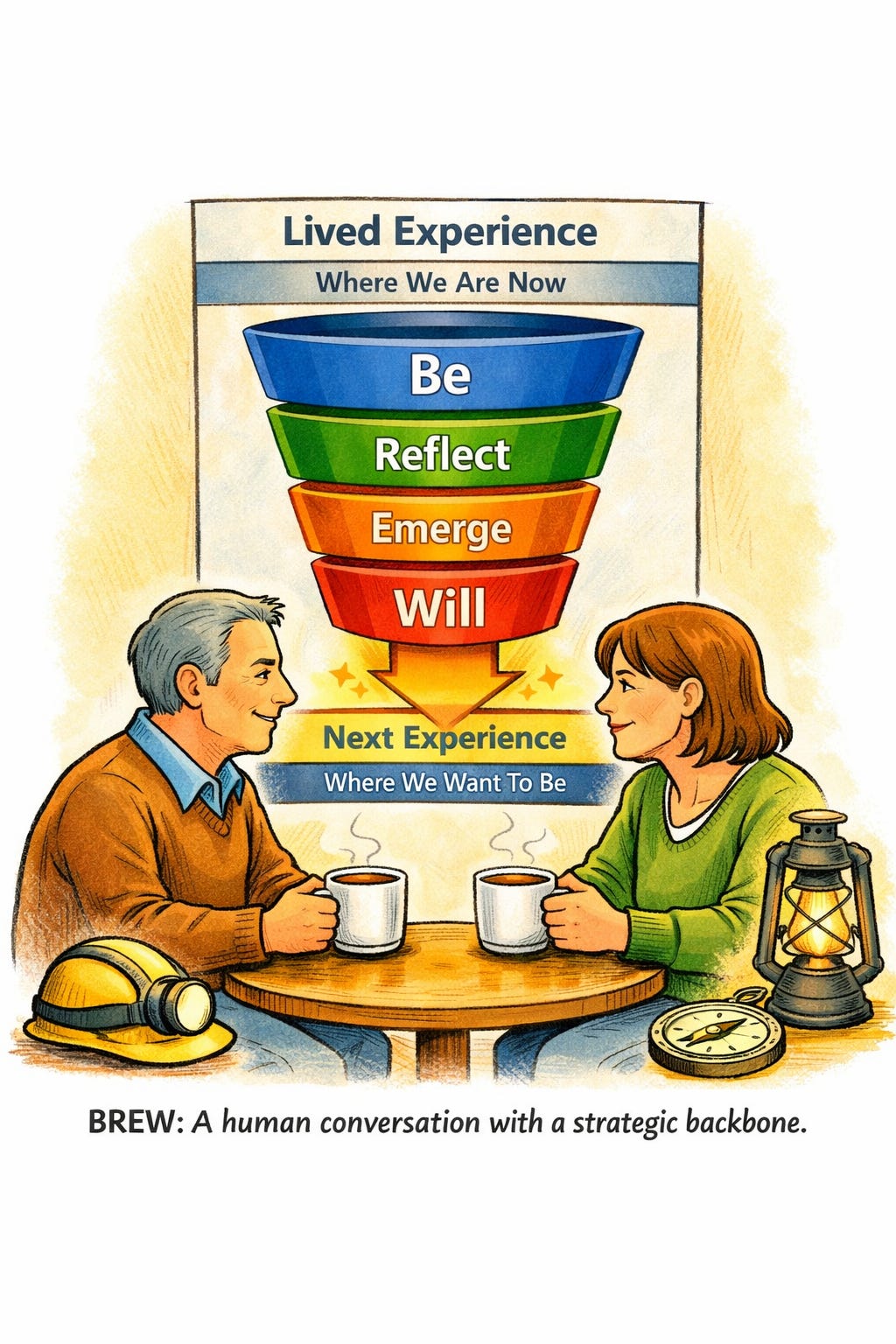
BREW isn’t just a lived‑experience model. It’s grounded in adult development theory, wisdom research, emotional intelligence, phenomenology, humanistic psychology, strategic coaching science and expertise development. BREW is not niche. BREW is not shallow. BREW is not performative. It’s a human strategy framework built on how adults actually grow.
It’s universal because the questions it works with are universal. Research shows that wisdom, judgement and coaching depth increase with age, and that humans - regardless of role or sector - face the same developmental challenges: clarity, direction, obstacles, meaning, action. BREW works because it speaks to the human condition, not a job title.
BREW wasn’t created to impress coaches. It was created to help humans think clearly. It’s a model built from lived experience, sharpened by strategy and grounded in the evidence of how adults actually grow. In a coaching world crowded with performance, jargon and theatre, BREW stays human - a conversation, not a script; a framework, not a façade. If it helps someone see their situation more clearly, choose a direction that makes sense and take action that moves them forward, then it’s doing exactly what it was designed to do. Simple. Human. Effective. A proper brew.